|
How to Run Syncthing 24/7 as a Windows Service with AlwaysUp |
Automatically start Syncthing in the background when your computer boots, without having to log on. Survive crashes, accidental shutdowns, and other interruptions
Last Updated on June 1, 2026
Syncthing keeps your important files synchronized between two or more machines.
It's well suited for running "headless" in the background as the GUI is accessible from any web browser.
To install Syncthing as a Windows Service with AlwaysUp:
-
If you don't have Syncthing installed, download the latest zip file
and expand it to a new folder on your hard drive.
Set up your folders in Syncthing and make sure that everything works as expected. It's best to have a functioning baseline before we install Syncthing as a service.
For this tutorial, we installed version 2.1.0 in "C:\Syncthing" and that folder will show up in later steps.
-
Download and install AlwaysUp, if necessary.
-
Next, start AlwaysUp.
-
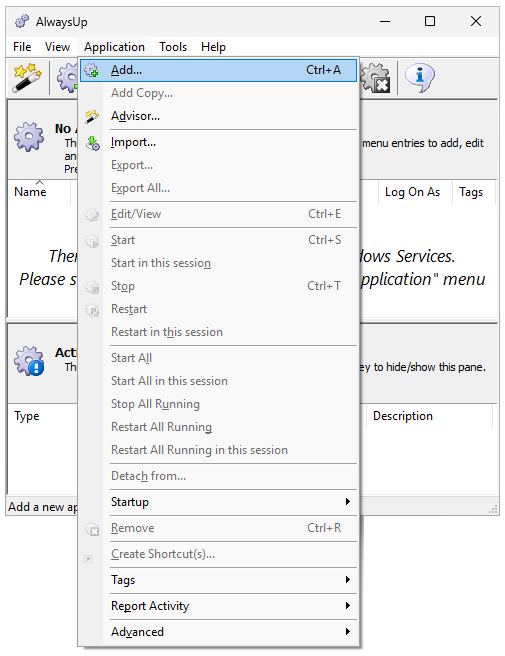
Select Application > Add to open the Add Application window:
-
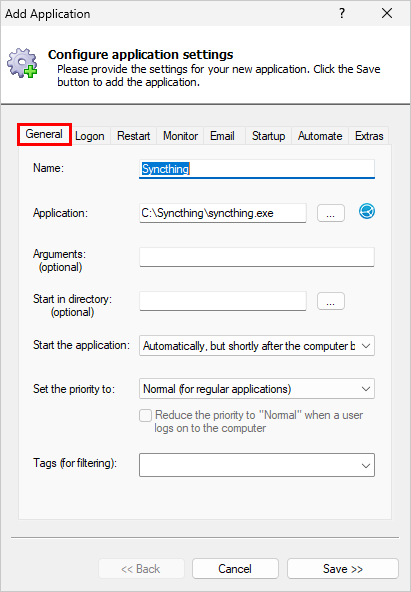
On the General tab:
-
In the Application field, enter the full path to the Syncthing executable, syncthing.exe.
This is "C:\Syncthing\syncthing.exe" on our machine but your path may be different.
-
In the Start the application field, choose Automatically, but shortly after the computer boots.
With this setting, Syncthing will start a couple of minutes after boot — after all the machine's critical
networking services are up and running.
-
Finally, in the Name field, enter the name that you will call the application in AlwaysUp.
We have used Syncthing (the default) but you can specify another name you like.
-
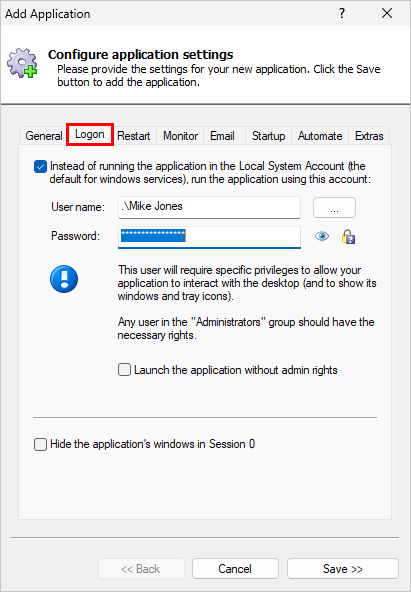
Click over to the Logon tab and enter the user name and password of the account in which you have configured and run Syncthing.
By default, Syncthing stores its settings in the user-specific %AppData% folder and running it in the same account will ensure that Syncthing will find its configuration.
-
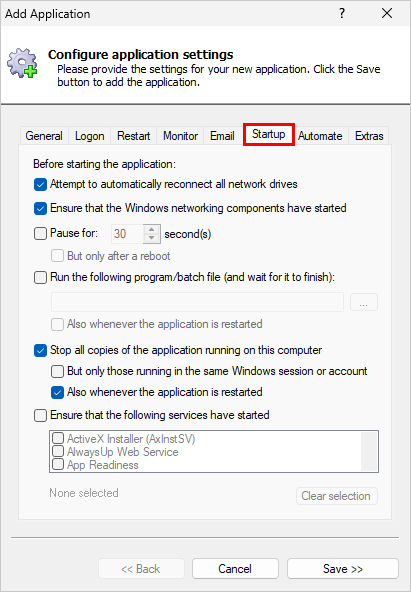
Move to the Startup tab:
-
Check the Ensure that the Windows Networking components have started box.
This tells AlwaysUp that Syncthing needs the TCP/IP networking stack to do its work.
-
Because only a single copy of Syncthing can run at any time (due to the use of a single network port),
check the Stop all copies of the application running on this computer box, and the Also whenever the application is restarted setting below.
That will ensure that other instances of Syncthing don't prevent the copy launched by AlwaysUp (as a Windows Service) from starting properly.
-
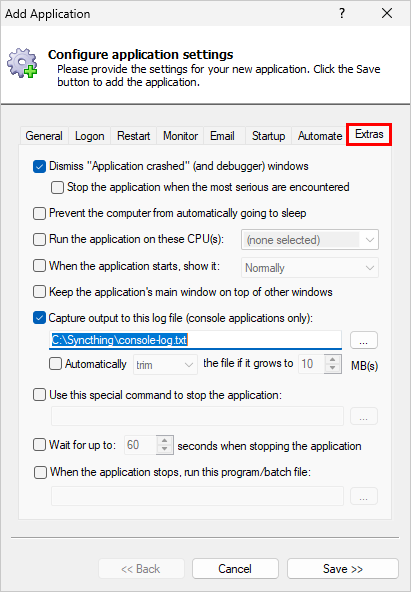
Since Syncthing will no longer be visible on your desktop, you may want to capture the messages from the console to a file.
To do so, switch to the Extras tab, check the Capture output to this log file box and enter the full path to a text file.
-
We're done configuring Syncthing so Click the Save button.
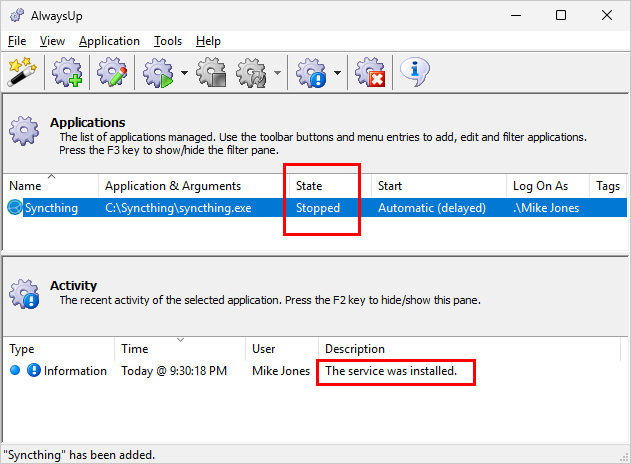
In a couple of seconds, an entry called Syncthing will show up in the AlwaysUp window.
It is not yet running though:
-
And now that we are ready to start Syncthing as a windows service, let's configure the software to avoid launching the browser when it starts (since you won't be able to see it any more). To do so:
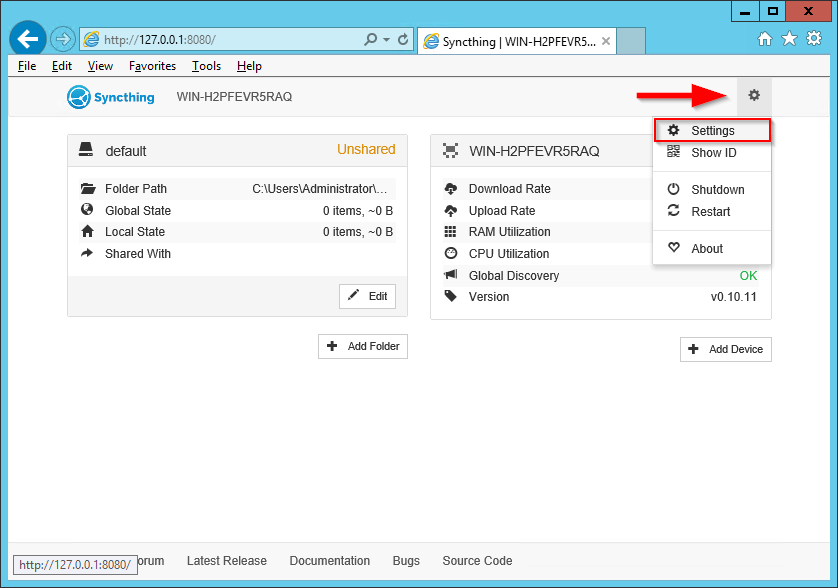
Start Syncthing. Open the web GUI in your browser (at http://127.0.0.1:8384 on our machine). -
From the Actions menu, select Settings:
-
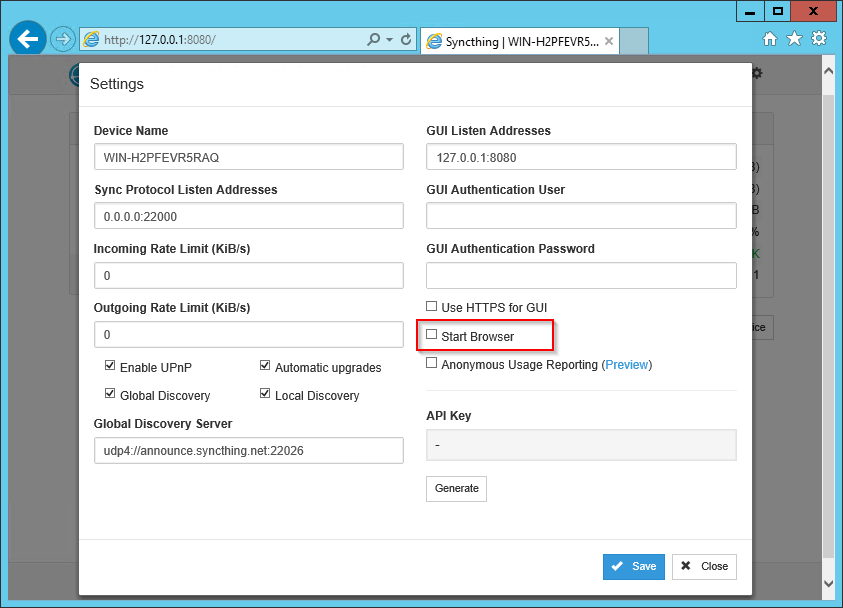
Uncheck the Start Browser box:
Save your changes.
-
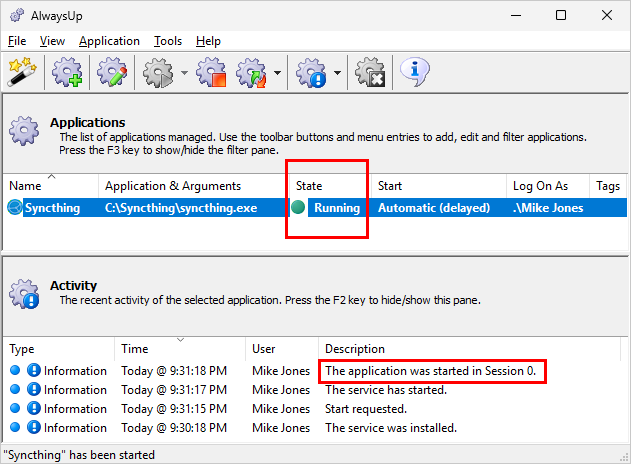
To start Syncthing from AlwaysUp, choose Application > Start "Syncthing".
After a few seconds, the state should transition to "Running" and Syncthing will be working in the background.
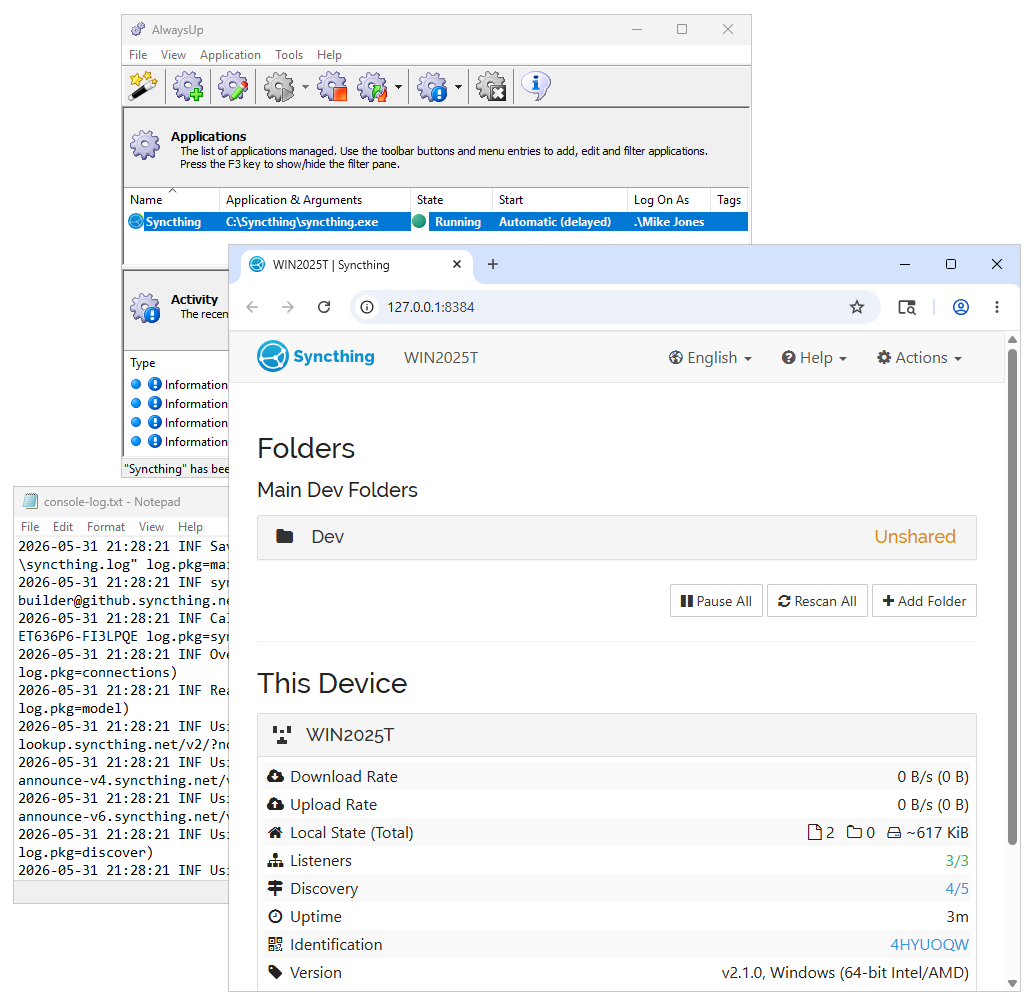
Open your browser and confirm that things work as expected.
On our server, the site opened up fine and the log file captured in step 8 was free of errors:
-
That's it! Next time your computer boots, Syncthing will start up immediately, before anyone logs on.
We encourage you to edit Syncthing in AlwaysUp and check out the many other settings that may be appropriate for your unique environment.
Syncthing not working properly as a Windows Service?
Consult the AlwaysUp Troubleshooter — our online tool that can help you resolve the most common problems encountered when running an application as a Windows Service.
From AlwaysUp, select Application > Report Activity > Today to bring up an HTML report detailing the interaction between AlwaysUp and Syncthing. The AlwaysUp Event Log Messages page explains what each message means.
Browse the AlwaysUp FAQ for answers to commonly asked questions and troubleshooting tips. Contact us and we will be happy to help!
|
Over 97,000 installations, and counting!
|
 |

|
Rock-solid for the past 20+ years!
|
Fully Compatible with 160+ Applications...
|