|
How to Run WS_FTP Professional as a Windows Service with AlwaysUp |
Automatically launch your WS_FTP script as soon as your computer boots and run it constantly, every few minutes. No need to log on to start FTP'ing your files
Last Updated on September 13, 2026
WS_FTP Professional is a leading commercial FTP client.
Its powerful scripting capabilities make it easy to transfer files and folders on demand, without having to interact with the GUI.
To run a WS_FTP script every 5 minutes as a Windows Service with AlwaysUp:
-
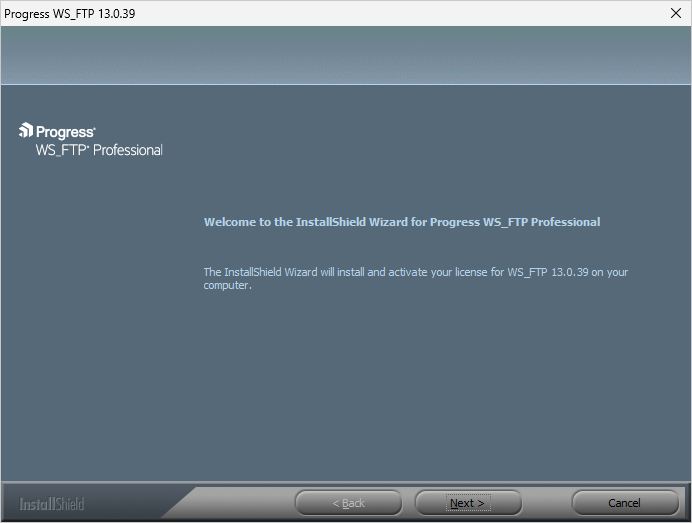
If necessary, download and install WS_FTP Professional:
Please ensure that your WS_FTP script works as you expect. If it doesn't work now, it won't work with AlwaysUp either.
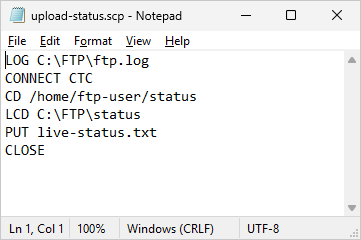
For this tutorial, we created a simple script that updates a status file on our website:
-
Download and install AlwaysUp, if necessary.
-
Start AlwaysUp.
-
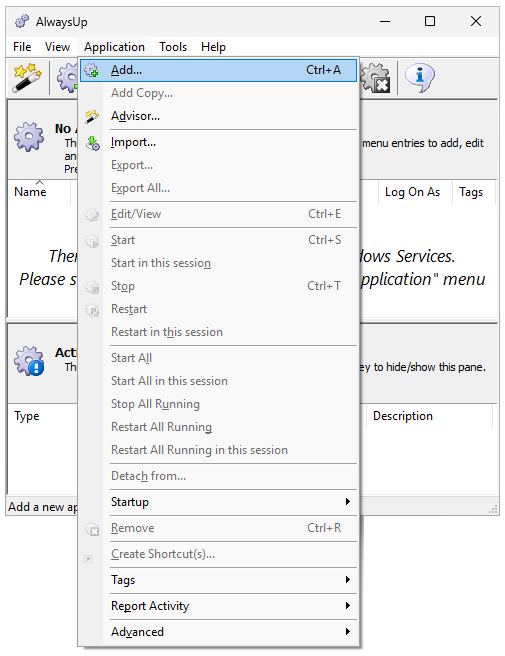
Select Application > Add to open the Add Application window:
-
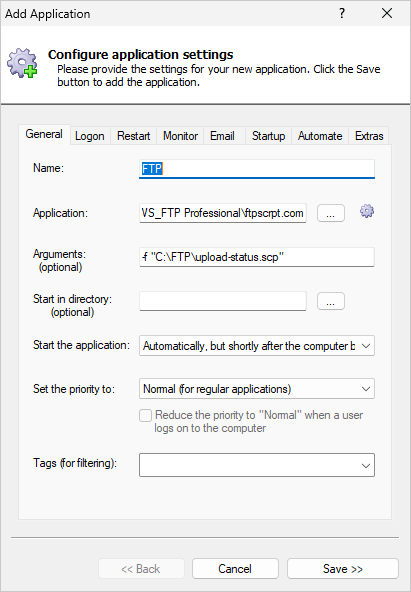
On the General tab:
-
In the Application field, enter the full path to the WS_FTP script command-line executable stub, ftpscrpt.com
If you installed WS_FTP in the default location, this will be:
C:\Program Files (x86)\Progress\WS_FTP Professional\ftpscrpt.com
-
In the Arguments field, enter -f followed by the full path to your WS_FTP script file.
-
In the Start the application field, select Automatically, but shortly after the computer boots.
That tells AlwaysUp to launch WS_FTP 1-2 minutes after a reboot — after critical Windows Services
(such as event logging and networking) have fully initialized and are ready to go. We don't want the FTP to start prematurely!
-
And in the Name field, enter the name that you will call the application in AlwaysUp.
We specified FTP but you can specify another value if you like.
-
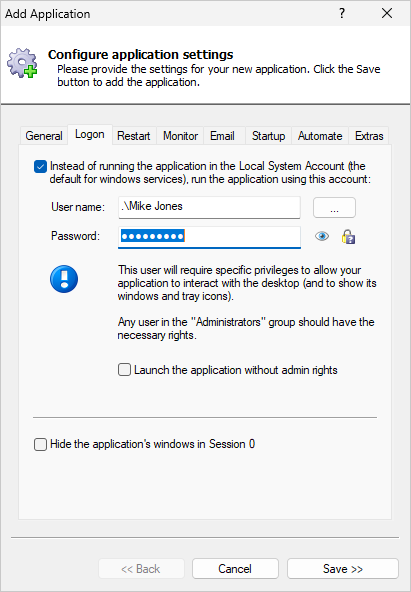
Switch to the Logon tab. Enter the user name and password of the Windows account where you installed and setup WS_FTP.
WS_FTP must run in this account to find its configuration/settings:
-
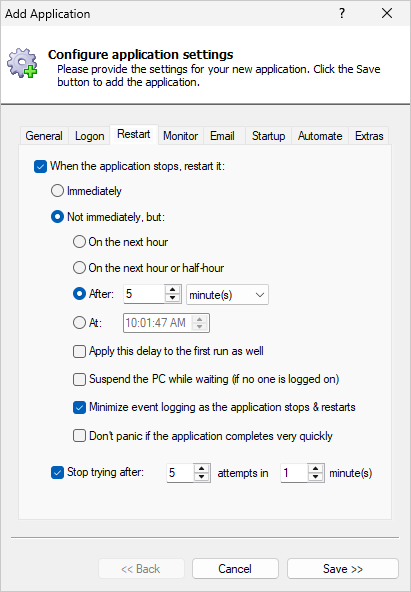
Move to the Restart tab, where we will specify how often to run your FTP script.
-
To run the script every 5 minutes, check Not immediately followed by After, then enter the period.
-
We also recommend checking the Minimize event logging... box.
If not, AlwaysUp will write 3-4 entries to the Windows Event Log each time your script is run — a potential annoyance for this scenario.
-
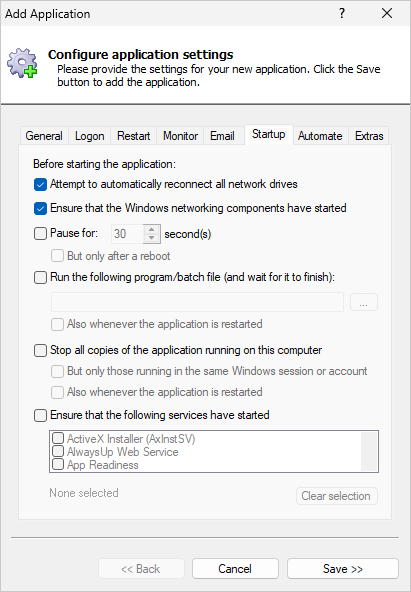
Finally, go to the Startup tab and check the Ensure that the Windows Networking components have started box.
This lets AlwaysUp know that WS_FTP needs TCP/IP networking support to do its work:
-
We're now done configuring WS_FTP to run as a service so click the Save button to record your settings.
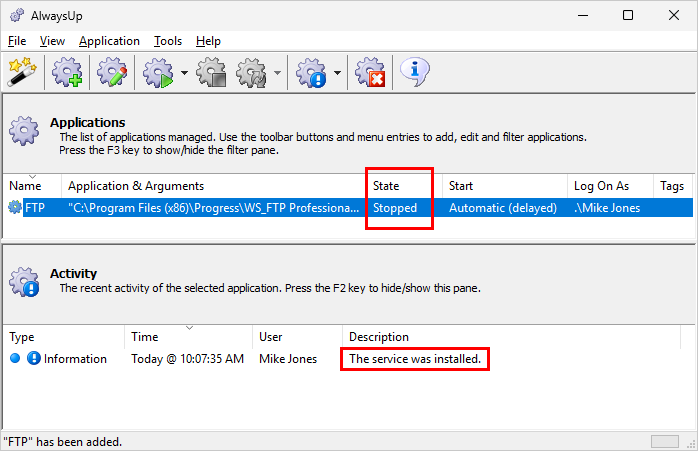
In a few seconds, an entry for FTP (or whatever you called it) will show up in the AlwaysUp window.
It is not yet running though, and the state will be "Stopped":
-
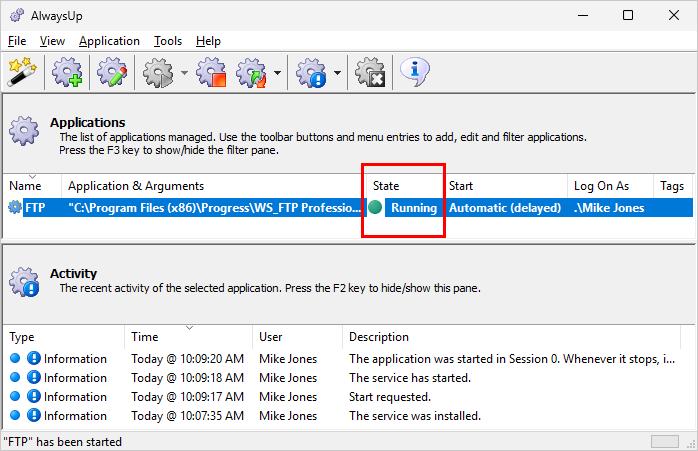
To start your WS_FTP script from AlwaysUp, choose Application > Start "FTP".
The service will start in the background and immediately FTP your files:
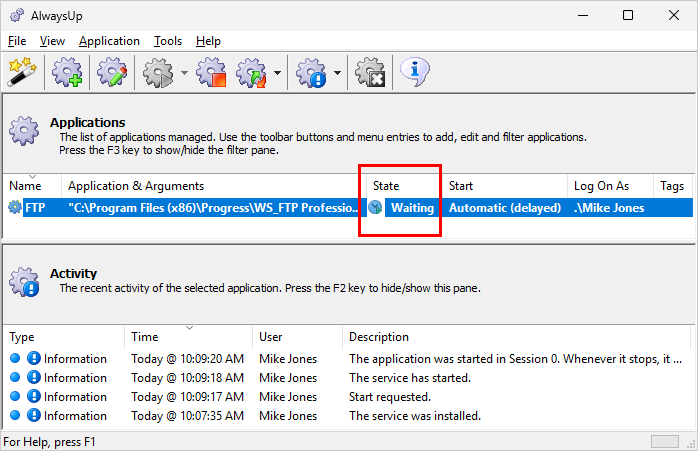
After that first run, the service will pause for 5 minutes before running the script again. You'll see the "Waiting" icon:
-
That's it! Next time your computer boots, your WS_FTP script will run immediately, before anyone logs on, and run again every half hour.
We encourage you to edit WS_FTP in AlwaysUp and check out the many other settings that may be appropriate for your environment.
WS_FTP Professional not working properly as a Windows Service?
Consult the AlwaysUp Troubleshooter — our online tool that can help you resolve the most common problems encountered when running an application as a Windows Service.
From AlwaysUp, select Application > Report Activity > Today to bring up an HTML report detailing the interaction between AlwaysUp and WS_FTP Professional. The AlwaysUp Event Log Messages page explains what each message means.
Browse the AlwaysUp FAQ for answers to commonly asked questions and troubleshooting tips. Contact us and we will be happy to help!
|
Over 97,000 installations, and counting!
|
 |

|
Rock-solid for the past 20+ years!
|
Fully Compatible with 160+ Applications...
|