-
If necessary,
download
and install HyperSQL for Windows. Please ensure that HSQLDB is properly configured and that you can start it normally.
Note that we placed the software in "C:\hsqldb" and we'll use that folder throughout this tutorial.
-
Formulate the Java command line you use to launch HSQLDB. Start with the full path to java.exe, which you can find by running "where java.exe" from a command prompt.
The User Guide notes the preferred format
and we will use that method for this tutorial. Here's our command line:
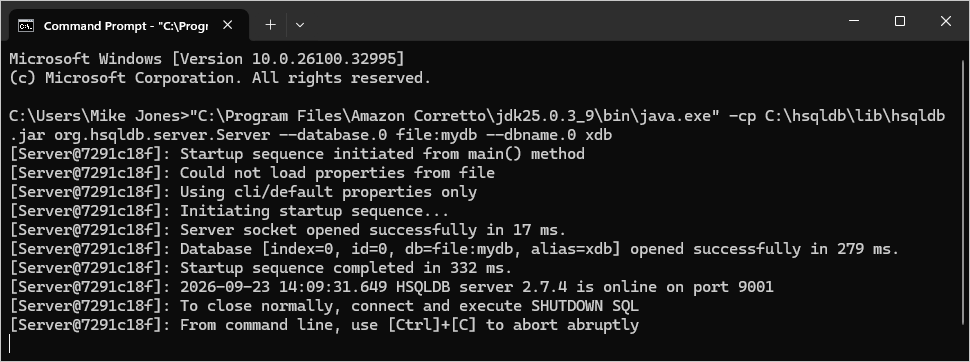
"C:\Program Files\Amazon Corretto\jdk25.0.3_9\bin\java.exe" -cp C:\hsqldb\lib\hsqldb.jar org.hsqldb.server.Server --database.0 file:mydb --dbname.0 xdb
HyperSQL started fine like that:
-
Download and install AlwaysUp, if necessary.
-
Start AlwaysUp.
-
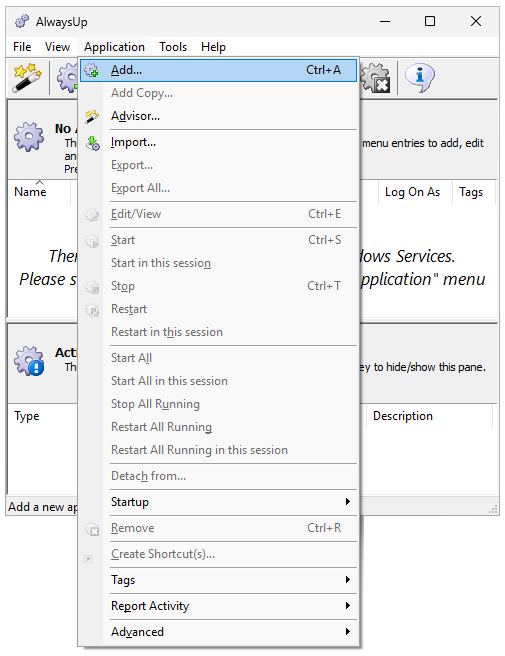
Select Application > Add to open the Add Application window:
-
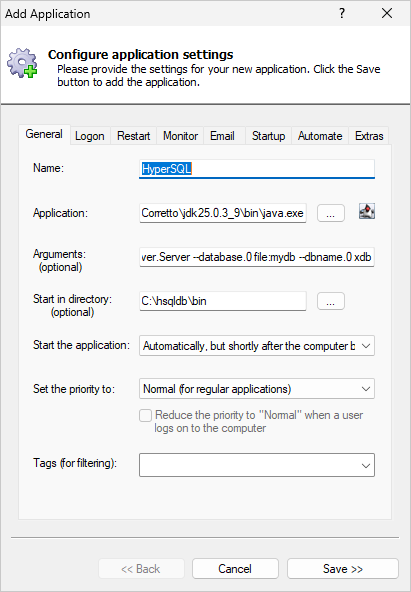
On the General tab:
-
In the Application field, enter the full path to the Java executable file (step 2)
-
In the Arguments field, enter all the parameters from the command line you use to launch HyperSQL (step 2).
-
In the Start in directory field, enter the full path to your HSQLDB bin folder. That's "C:\hsqldb\bin" on our machine.
-
In the Start the application field, choose Automatically, but shortly after the computer boots.
With this setting, AlwaysUp will launch the database a couple of minutes after boot — after all the machine's critical services are
up and running.
-
And in the Name field, enter the name that you will call the application in AlwaysUp.
We suggest HyperSQL but you can specify almost anything you like.
-
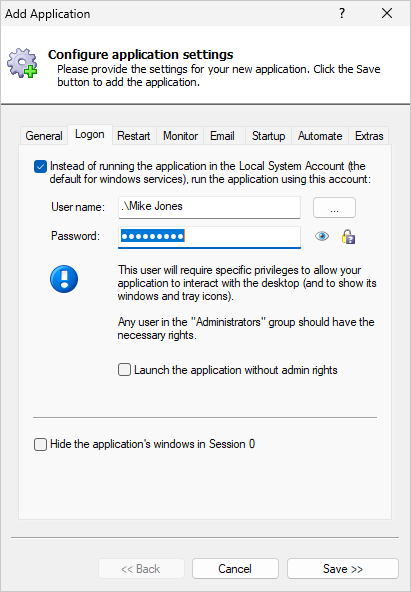
On the Logon tab, enter the user name and password of the Windows account you are logged into when you start HyperSQL.
HSQLDB should run in this account to find its Java settings (environment variables, etc.):
-
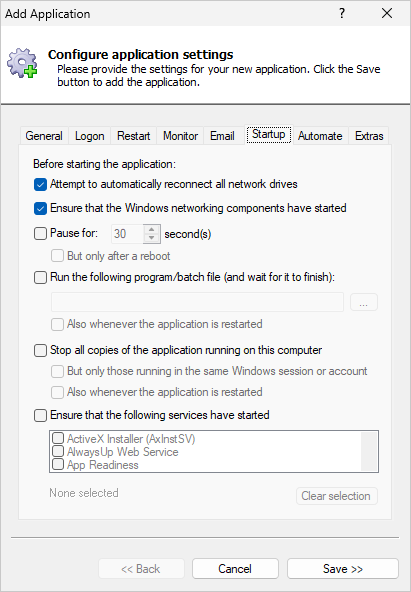
Move to the Startup tab and check the Ensure that the Windows Networking components have started box.
This informs AlwaysUp that HSQLDB needs the TCP/IP networking stack to operate.
-
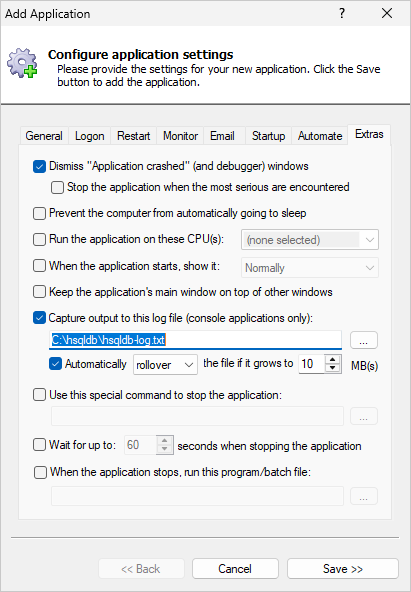
Move to the Extras tab.
If you wish to capture the text normally displayed on the Java command window
(recommended, as you will no longer see the console when it's running in the background as a service),
check the Capture output to this log file box and specify the full path to a file. For example, we specified "C:\hsqldb\hsqldb-log.txt".
-
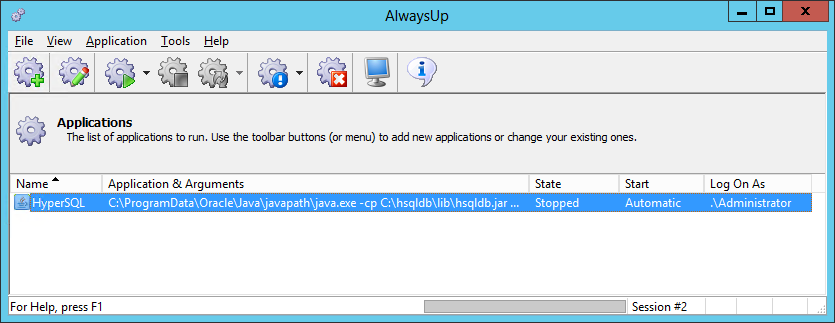
Click the Save button. In a couple of seconds, an application called HyperSQL will show up in the AlwaysUp window.
It's not yet running though:
-
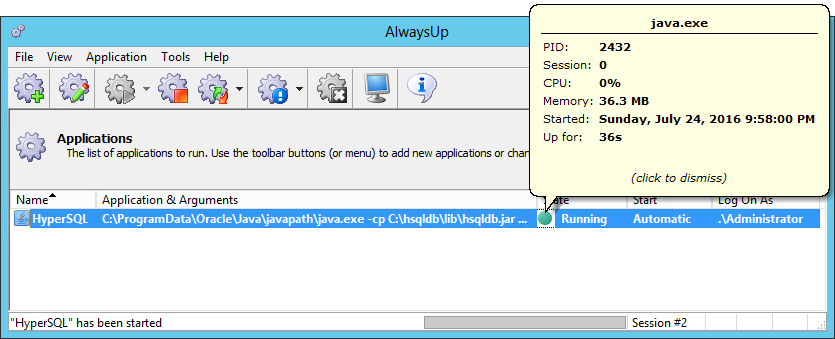
To fire up your database, choose Application > Start "HyperSQL".
The State column will transition to "Running" after a few seconds and HSQLDB will be available to all your applications.
-
That's it! Next time your computer boots, your HyperSQL database will start up automatically, before anyone logs on.
We encourage you to edit HyperSQL in AlwaysUp and check out the many other settings that may be appropriate for your environment.
For example,
setup email notifications,
improve performance by boosting the priority of your Java process,
or periodically restart the DB to cure memory leaks.